Science: Find in Kenya confounds the belief
in a single early ancestral species, experts say.
By ROBERT LEE HOTZ, Times Science Writer
Thursday, March 22, 2001
Translated by Xanthe
Discovery of an Ancient Skull Clouds the Origins of Humans
|
Science: Find in Kenya confounds the belief |
Throwing the origins of humankind into question, researchers in Kenya have
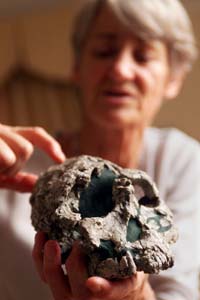
unearthed a battered but almost complete skull of a new human species with a
surprisingly delicate face dating from 3.5 million years ago.
The new species is nestled in the roots of the human family tree during a period
when scientists thought only one ancestral species existed, leaving it unclear
just which was the direct forebear of modern humankind.
Using their new specimen to rework humanity's pedigree, paleoanthropologist Meave Leakey and her colleagues at the National Museums of Kenya in Nairobi argue in research made public today that the small-brained creature is so unusual it belongs not just to a new species but to an entirely new genus. They formally christened it Kenyanthropus platyops--the flat-faced man of Kenya.
Its tiny teeth, distinctive jaw structure and relatively modern face set it
apart from the only other early human species known to have been alive at that
period, the researchers report in Nature. That species, called Australopithecus
afarensis, is best known for the 3.2-million-year-old skeleton called Lucy.
Until now, it was thought to be humanity's direct forerunner.
"The differences [between the two species] are so obvious and significant,"
Leakey said. "They are the opposite of what you would expect."
The find is further evidence that humanity emerged from an evolutionary maze
of false starts, dead-ends and competing adaptations to its African homeland,
several experts said.
So far, few people outside Leakey's team have been able to examine the new fossils
directly. Based on details published today in the research report, however,
many experts in the study of human origins hailed the find as provocative--albeit
unsettling--evidence of early human diversity.
"This is both a very welcome and at the same time extraordinarily intriguing
fossil find," said Donald Johanson of the Institute of Human Origins at
Arizona State University, who discovered the Lucy fossils in 1974.
"It is certainly a new species," he said. "And the unique combination
of anatomical characteristics in this specimen probably do justify a new genus."
Even so, Johanson still believes afarensis is a likely candidate for the direct
ancestor of modern humans.
Paleoanthropologist Ian Tattersal at the American Museum of Natural History
in New York praised the "courage" of the Leakey team in naming an
entirely new genus, rather than fitting the new fossils into the existing categories.
That, he said, provides the "intellectual elbow room" to deal with
the unexpected diversity of human fossils.
"Diversity has clearly been building up with every discovery, and this
is breaking open the possibilities so we can get to grips with it," he
said.
Andrew Hill, curator of anthropology at Yale University's Peabody Museum, agreed
that the new fossils are persuasive evidence of the existence of a new early
human species.
"It is a really odd thing with an unanticipated set of characteristics.
The flat face to me is odd. This isn't particularly apelike," he said.
"You tend to expect early hominids to look more like chimpanzees.
"It does appear that you have diversity going back much further than anyone
thought."
F. Clark Howell, a UC Berkeley expert on human origins, said the discovery "substantially
changes the structure and the classification of very early manlike creatures
in this period of time. There is more diversity and it is more profound than
what we have been led to believe."
All told, the new specimen is the sixth pre-human species to be discovered in
the last decade, encompassing up to 4 million years of human evolution.
Taken together, these growing collections of age-stained fossil teeth, broken
femurs, bone shards and shattered skulls have turned the scholarly procession
of human descent into a parade of primitive hominids vying for a prominent place
in the pecking order of evolutionary history.
The ensuing scientific debates pit passionately held theories about human origins
against the reality of a remarkably sparse fossil record. The newest discovery
sheds light on an especially important period of human development.
"Until this skull was found, there was only one kind of early hominid
[in this period] that you could possibly make ancestral to humanity," said
University of Utah geologist Frank Brown, who helped determine the age of the
rocks in which the fossils were preserved.
"This makes people rethink these relationships," Brown said. "It
says there was more than one kind of creature running around then related to
us."
Already, several scientists have suggested that the newly discovered species
might supplant afarensis as the most likely line of direct human ancestry. Leakey
stopped short of making that claim, saying that she would not be surprised if
even more early human species turned up in the same period of evolutionary history,
any one of which might be a better candidate.
"I don't have any scientific grounds to say that this is directly ancestral,"
she said Wednesday in an interview in Los Angeles. "It certainly is a branch
of the human family tree, but it may be a twig that became extinct."
Unearthed two years ago from an arid stretch of northern Kenya's Great Rift
Valley near Lake Turkana, the skull was first spotted by research assistant
Justus Ertus protruding from a layer of mudstone that had concealed and protected
it for millenniums. The researchers carefully uncovered a softball-sized brain
case warped from the pressure of the surrounding rock and cracked by the roots
of the tough grass growing over it, the oldest known complete cranium of any
member of the human family.
"It was in very poor shape," Leakey said. "It was quite a difficult
excavation. It took an entire day."
In all, only about 30 fragments of skull and jaw were found, but no long bones
or ribs. So much about the creature is still guesswork.
Leakey suggested that it was not much taller than a modern chimpanzee and may
have weighed as much as 55 pounds. Its brain may have been no larger than that
of an ape.
From the small size of its teeth and the shape of its jaw, Leakey surmised that
it may have fed on relatively soft fruit and insects rather than more abrasive
grasses and tough roots of the ancient bush land.
"Afarensis evolved in one direction and this went in another," Leakey
said. "There were probably . . . differences in what they were eating,
and so they were not competing."
The research was underwritten by the National Geographic Society and the Leakey
Foundation in San Francisco.
Sourch: http://www.latimes.com/news/science/science/lat_skull010322.htm